Friday, November 17, 2017

Remembering

November is a time when we collectively as a country stop, stay silent and remember the dedication and sacrifice of others in times of conflict around the world.  Schools are amazing places to ensure that we learn about the significance of peacekeeping around the world and our responsibility to be agents of peace.

As Christian Schools and communities, we are blessed beyond measure as we process the events in our world that have and continue to show pain and suffering in the face of injustice, wrongdoing, and evil.  We know that as agents of peace, we ultimately serve the Prince of Peace, the King of Kings.

This past week, we were learned through the participation of veterans, interaction with local Legions, the preparation of band pieces, dramatic vignettes, and art projects that helped us ask questions and delve into the meaning of sacrifice and justice and how to respond to the problem of evil in the world.  In a Christian school, we are able to process together with students and in community, singing and remembering together that we have a 'Saviour, who is mighty to save'.

As we pause for a moment of silence this weekend to remember those who served and sacrificed for our freedom, may we be reminded of God's continued work of restoration in the world.  The words of Saint Francis are an apt reminder of this paradox and call:

Lord, make me an instrument of your peace:
where there is hatred, let me sow love;
where there is injury, pardon;
where there is doubt, faith;
where there is despair, hope;
where there is darkness, light;
where there is sadness, joy. 

O divine Master, grant that I may not so much seek
to be consoled as to console,
to be understood as to understand,
to be loved as to love.
For it is in giving that we receive, 
it is in pardoning that we are pardoned, 
and it is in dying that we are born to eternal life.

Friday, October 20, 2017

Complaining or Communicating?

As we learn some of our community character traits this year, connected in Christ, there are times when we will notice that there is an intersection of a few of them resulting in new discoveries.

Last week I wrote about compassion, how vital it is, but how difficult it can be as well.  In light of how our contemporary society works, compassion for those with whom we have a problem or issue is counter-cultural.  Our culture tells us that when we disagree or have an issue with someone, the proper way to go about it is to either a) put up a public and vocal protest about it (social media makes this even easier than ever before), or b) to 'suck it up' and move on.

Honesty and Integrity, as well as collaboration, are other traits we are looking to deliberately focus on and develop in our students and in our community.  A few times a year, I hear the phrase: "We didn't want to be the complainers....." or "I would have told you about this sooner, but I didn't want to bother you...."  I know the principals hear this as well.  

If we have an issue with someone, one of the easiest things we can do is discuss it with close friends.  While this can be healthy, we need to watch closely that our discussions remain guarded to protect everyone.  If there is something bothering you, as soon as possible, take it up with those involved.  Problems are dealt with appropriately, quickly, and the right information can come to light.

Proper handling of conflict or issues is an act of compassion, an act of collaboration, and an act of integrity.  While it may seem odd to suggest that complaining or stating that something isn't right is compassionate, the alternative is far worse.  If we allow conflict or issues to fester or spread without being dealt with, they can become toxic, fodder for gossip, and destructive to anyone involved as well as to our community.  

Attached to today's newsletter is NACE's dispute reconciliation policy.  This policy applies and involves everyone in our community - employees, parents, supporters, and board members.  Please review it so that you know how to issues should they arise, but also so that you can encourage others to deal with them appropriately.  'Have you talked to _____________ about this?' should be a quick reminder to one another to resolve problems.   Matthew 18 provides sound advice from scripture not only to settle disputes but also to proactively protect the Christian community from itself as we know we all fall short at times.  Speaking the truth in love is a habit that goes a long way to developing character and a growing healthy community of learning that is connected in Christ.

Compassion


Compassion seems simple. On the surface, compassion is a trait in which we feel sorry for someone and try to help. This wouldn't be wrong, but there is so much beyond a simple empathetic posture that is embodied in a character trait of compassion.

As we move through some of our 'Connected in Christ' character traits, they align well with how we understand the course of God's redemptive hand in history (some of you will know this as the creation-fall-redemption framework). God's creation gives us reason to be curious and to delight in his work. Our story takes a turn, however.... because of humanity's decision to disobey and to move away from God, we live in broken relationship with Him and with the world. There is hurt, there is pain, there is suffering. In fact, scripture describes the world as 'groaning' under the weight of our sin (Romans 8:12)

This calls for a response. God showed His compassion by designing a rescue plan for us and for his world. He calls us to exhibit also this compassion for creation, and for one another.

Students and teachers deal with this on a regular basis in their classrooms. On some level, it is easy to have compassion for the person who is seeking help and wanting to be assisted. It makes us feel good to help. What is it like to have compassion for the person who doesn't want or feel they need it? How about the person we don't know or feel threatened by? So much of our world right now lives in a tension of fear and negativity because we don't take the time to identify with and understand one another. It's easier to label what we don't know or understand as 'wrong' or 'harmful' or even 'unchristian' when in fact we haven't taken the time to understand their story.

Compassion is a response to pain and suffering and conflict. We may have caused it, or we may see it unfold in front of us. The next time your kids (or you!) see hurt or pain in the world.... ask them 'How can we be compassionate here?' Sometimes it will be obvious. Sometimes the answer may be "I think I just need to better understand who that person is and what they are dealing with...."

We live in a broken and fallen world, but God is active in it around us and through us. How can we complete this learning target: "I can show compassion by _____________."

I look forward to hearing more stories of surprise from our students, teachers, and you about how compassion is being expressed within and beyond our learning community.

Friday, September 15, 2017

Curiosity

Sometimes curiosity gets a bad rap.  Apparently, it killed the cat, or so they say..... It can get us into trouble, especially as children.  How many times were we as children reminded to 'mind our own business' when we pried into our parents' world?  How many times were we told not to worry about things we questioned about or cautioned against exploring parts of the world that are dangerous? Certainly, curiosity can lead to dark and dangerous places from which we need to adequately protect our children.   But what is that seemingly insatiable need to explore and know more that is built into us and into each child?  It is a gift from God that He created us with - a pre-existing condition that prepares us to fulfill His blessing and command:  "Then God blessed them and said, "Be fruitful and multiply. Fill the earth and govern it..." " (Genesis 1:28a)

In an article she wrote for Chrisitan Parenting, Sharon Miller reminds us that our task "...is to raise children who want God. When our kids inherit a holy curiosity, they will never stop exploring their infinite Creator and never stop asking for more of him."  It's why our Community Character traits begin with curiosity.  It is that posture of excitement and desire for more that sets us up as people who seek God and to fill His creation.  It is central to our task not only as guardians and rulers of creation, it is also central to our need to know God more and to connect with Him.  In order to be a student, we need to be curious; and God, knowing that, built it right in!  

It also reminds us that we don't need to answer every question that our kids or students ask with a factual answer.  Sometimes they need to wonder, to exercise their curiosity, to search for wonders in creation, to search for God.  The next time your child asks 'Why?' (and perhaps it will be the 100th time that day!), thank God for planting curiosity in each of us, and pray that we as a school community can celebrate that need to know, desire to learn, and thirst for God in our students!


Wednesday, September 13, 2017

Connected in Christ

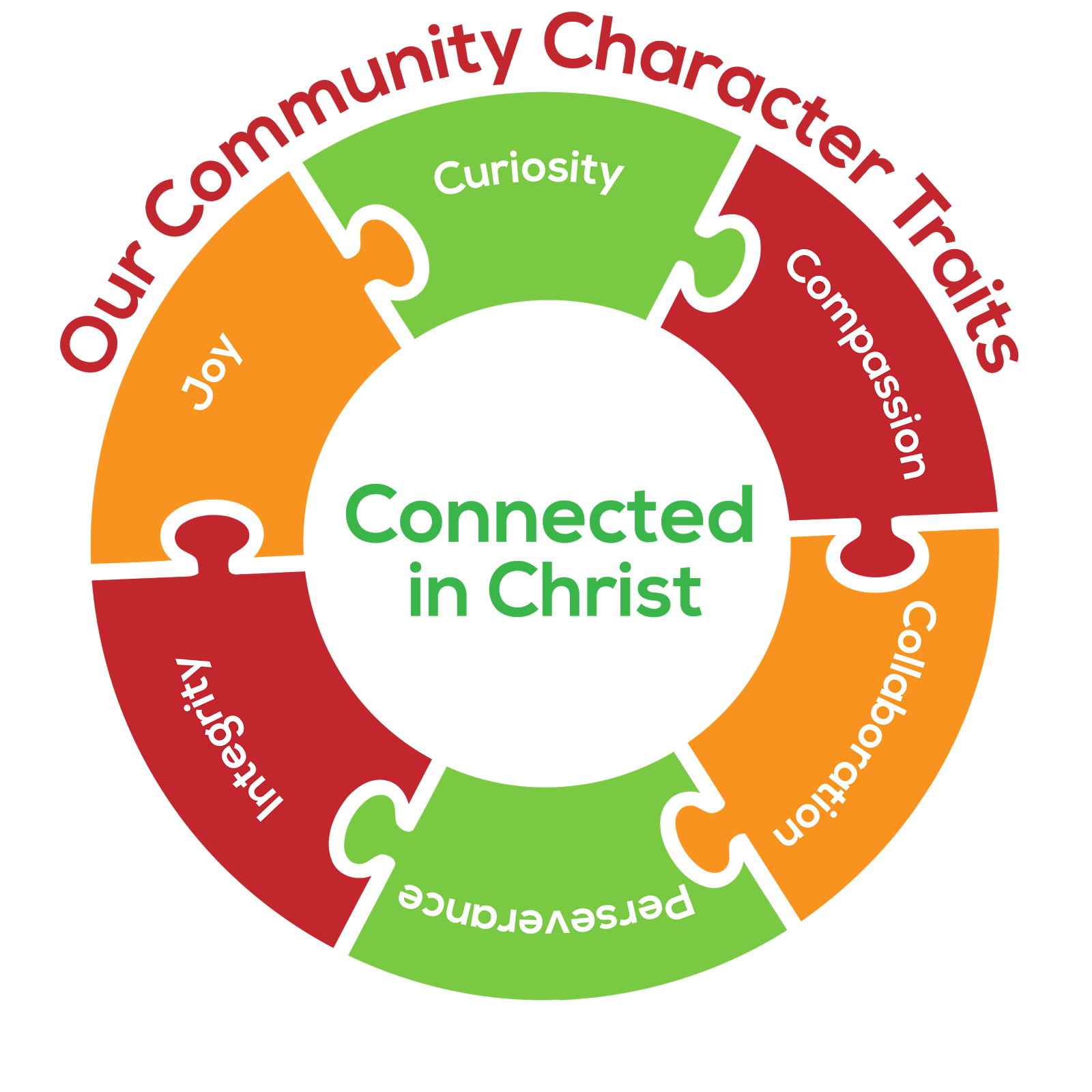
By now, you have all been introduced to the six character traits that surround our schools' themes this year. These six traits are part of a longer story that originated more than a year and a half ago when we asked the NACE community 'Why?'

Why do you send your kids to a Christian School? Why is Christian Education important? What do you hope for in Christian Education?

These important questions revealed some important data which included a number of things that we would all expect: We knew that the foundational world-and-life view that keeping Christ at the centre of all we study was important. We also knew that we all desire a safe and loving place for our students where we know that they will be cared for as children of God and image bearers of Him.

One other item surfaced loud and clear at that time: You had a deep desire to see your children live out their Christian faith in a real and tangible way - not just as head knowledge, but as heart and hands knowledge as evidenced by character and service.

As a teaching staff, we dove deep into this concept to uncover what character traits we could intentionally develop over the long term that would not only encourage deeper learning and academic excellence but ones that would model Christ and discover His story in our lives.

You will hear more about these six character traits over the coming months and years. We don't intend just to 'teach' them to our kids. We intend to make them central to who we are and how we do things as an entire learning community - entering with Curiosity, and responding in Joy. Working with Compassion, Collaboration, Integrity, and Perseverance in all that we do.

In living and working together, we are connected together, to God's world, and in Christ.

Blessings to all of you as we enter into a new year of living, learning and serving together to God's glory!

Monday, May 1, 2017

Helping the Kingom come about

The title of this week's ED-you-cate comes from a chapter of a book by Henri Nouwen called 'A Spirituality of Fundraising'.  Nouwen is one of my 'heroes of the Christian faith' and I have grown to love his writing over the years.  This little book is no exception.  It was required reading for an administrator's conference I attended last week, where we were inspired and encouraged to articulate our organization's mission in the world, and how that related to the kingdom of God.  

I spent the next evening with a large group of 'friends of NACE' at our annual board fundraising dinner event, and shared for devotions the following passage from Nouwen's book:


Fundraising is a very concrete way to help the kingdom of God come about. What is the kingdom? Jesus is clear that if we make the kingdom our first priority, "all these other things will be given you as well' (Matt. 6:33, NJB). The kingdom is where God provides for all that we

need. It is the realm of sufficiency where we are no longer pulled here and there by anxiety about having enough. 'So do not worry about tomorrow; tomorrow will take care of itself" (Matt. 6:34, NJB). Jesus also compares the kingdom to a mustard seed," which, at the time of its sowing, is the smallest of all the seeds on earth.Yet once it is sown it grows into the biggest shrub of them all and puts out big branches so that the birds of the air can shelter in its shade' (Mark 4:31–32, NJB).

Even a seemingly small act of generosity can grow into something far beyond what we could ever ask or imagine (see Eph. 3:20)—the creation of a community of love in this world, and beyond this world, because wherever love grows, it is stronger than death (1 Cor. 13:8). So when we give ourselves to planting and nurturing love here on earth, our efforts will reach out beyond our own chronological existence. Indeed, if we raise funds for the Creation of a community of love, we are helping God build the kingdom. We are doing exactly what we are supposed to do as Christians. Paul is clear about this: "Make love your aim" (1 Cor. 14:1, NJB). (Nouwen, 2004)


That evening, amongst the great service(thank you, NACE board!), excellent food, and fantastic entertainment it was obvious we were in a community of love, and that they, in turn, were supporting our schools as communities of love.  The kingdom of God depends on small and large gifts alike, and He will bless those far beyond what we could ever imagine.  With your time, your talents, your resources, and your finances give knowing that you are a part of the Kingdom, where we are making love our aim!!!


Monday, April 24, 2017

Everything is different, everything is the same


Christian Education Week 2017 at both CCS and JKCS is a 'wrap'. What an exciting time to be in our schools as students eagerly awaited and greeted visitors, as people experienced us for the first time, and still others who have watched us grow since before we had our own buildings. Many, many wonderful interactions took place over the past two weeks, but an underlying sentiment struck me, in the words of a few of our grandparents in discussion with me: "Wow, education has changed a lot in the past few decades.... and is that ever a good thing!"

The grandparents have changed a great deal as well! One image that will stick in my mind for a long time is that of a visiting grandparent couple taking a 'selfie' on their smartphone with their grandchild in the classroom. At the moment, it was a major mental shift for me, but also seemed so normal and natural. As they looked around, they noticed other things that are 'different': the desks and chairs aren't all in rows, there isn't necessarily a textbook and workbook for each subject, technology is present but not front and centre, the principal and teachers are not filling positions of authority over students but of relationship WITH students.

"Why is it a good thing that things have changed?", I asked.
"The kids are at the centre." was the answer.
Simple, yet equally profound. This will stick with me for a while.

Just as nearly every workplace in our society has changed (some dramatically) over the past decade, so has the education work/learning place. I've had a few visiting parents come in to see JKCS or CCS, hoping to give to their children "the same experience I had as a kid." It's an interesting conversation that ensues. "Everything is different, and everything is the same," is one of my answers. We do not 'do' education the same way I experienced it when I attended Christian School. Students engage in learning experiences very differently than the traditional teacher-directed format of the past. However, we still teach and weave through everything we do that God is the LORD of all, that Christ is the saviour of the world, and the Spirit is active in our lives and in our everyday. In fact, decades of experience and research has taught us new ways to make this relevant and alive for students.

What is so exciting for me? That fact that grandparents are encouraging us to forge forward. They have seen generations of change and perhaps aren't so afraid of it. They certainly are passionate and excited about our current growth at NACE and the ways in which they see their grandchildren thriving. To God be the glory in each new day, with each new change, and in the ways in which we continue to seek Him in all that we do.
_______________________________________________

The Christian Courier, a Reformed Biweekly publication, released a special Christian Education Issue on April 24, 2017. The whole issue is a great discussion about Christian Schooling in Canada. One column, in particular, was a fantastic read. By Kathy Vandergrift entitled 'School bullying: Zero-tolerance to mutual respect'. I have included it at the end of today's print version of Journey/Connection. If you are reading a digital version, you can access it here: https://goo.gl/S9ApgG